


New Upcoming
Introducing IEEE 7012: My Terms January 28, 2026 4PM GMT / 11 AM EST Online or In-person in London, UK. Brought to you by Customer Commons, IEEE, MyData Global, Consumer Reports, Inrupt, Customer Futures Ltd, JLINC Labs, Midwest Fables.
KERICONF26 April 21-23 2026, Lehi, Utah (US)
Upcoming
These were all listed in previous newsletters
Call for Papers Open Now Open Identity Summit Deadline: January 31st, 2026
The summit takes place May 21–22, 2026 at University of Applied Sciences Dresden (HTW Dresden) in Dresden, Germany
Protocols for Publishers PfP✨ London on Feb 4-5, 2026 to discuss how we can preserve an open, equitable web, where no one company holds the keys.
MOSIP Connect, Rabat Moroco, Feb 11-13. Feb 13th is an unconference day facilitated by Kaliya. Reach out to me for an invite.
Workshop: CREDEBL For Decentralized Identity and Verifiable Credentials, Wednesday, February 18 at 8 AM Pacific Zoom
Join us at the 1EdTech Digital Credentials Summit in Philadelphia, February 18-20, 2026.
DIF Unconference Africa (an IIW Regional Event) Feb 24-26, 2026 Cape Town
Internet Identity Workshop #42, April 28-30, 2026, Mountain View California
Agentic Internet Workshop #2, May 1, 2026, Mountain View California
dice: Digital Identity unConfernece Europe (an IIW Regional Event) June 22-24, Copenhagen, Denmark
Business Advice
Verifiable Credentials: Why “Build Your Own Ecosystem” Is a Death Wish
If you are not: a government, Apple, or Google…then there are only two viable strategies in verifiable credentials:
Align tightly and early with government/EU standards and capture critical mass, or
Become a strong niche player solving one painful verifier workflow end-to-end.
Everything else, especially “let’s build our own ecosystem”, is a slow-motion failure.
Opportunity
MOSIP Inji Community – Expression of Interest (EOI) Now Open!
If you’re enthusiastic about contributing to a global digital public infrastructure project, fill out the form below and we’ll reach out with next steps and community contribution guidelines.
Learning
(LF Education) LF Insider: DID Under the Hood: Storage, Resolution, and Integrity
Explore the technical architecture of Decentralized Identifiers (DIDs) by learning how identity documents are stored across different networks, resolved into standardized formats, and cryptographically verified for tamper-evident trust.
Looking Ahead
(Spokeo) 5 emerging digital ID trends in 2026 that could redefine your online persona
In the end, the adoption of these emerging technologies ensures that identities can be accurately digitally verified and that people’s private information is kept out of the wrong hands. Through constant technological progress and innovation, digital ID verification is becoming more secure and more user-friendly than ever before.
Thoughtful
Democracy’s Missing Protocol: Fixing the Social Dilemma Without Censorship
Passwords are a National Security Risk
Standards
(Heather Flanagan) A Field Guide to Digital Identity Standards Bodies
New Versions of Standards
DCI [Digital Convergence Initiative ] Publishes v1.0.0 Interoperability Standards for ID Systems and Social Protection Platforms
The Digital Convergence Initiative has published Version 1.0.0 of its ID systems and Social Protection systems interoperability standards, a framework intended to help national identity programs and social protection delivery platforms exchange data and authenticate users more consistently. DCI is positioning the standards as a way to improve service delivery, reduce fragmentation across government systems, and support inclusion through more interoperable identity-linked benefits infrastructure.
VCALM v0.9: A Verifiable Credential API for Lifecycle Management
Verifiable Presentation Request v2024: A data model for requesting presentations of verifiable credentials
New Product Launches
Telefónica Tech launches a solution for private and secure control of personal information
Telefónica Tech, Telefónica’s digital business unit, launches a self-sovereign identity solution based on verifiable credentials to help companies and public organisations adapt to and implement the European Union’s new legal and technical framework for Self-Sovereign Identity (SSI), whose reference project is the EUDI Wallet, which will come into force at the end of 2026 in all member states.
Telefónica Tech launches self-sovereign identity tool based on verifiable credentials
Telefónica’s digital business unit, Telefónica Tech, has announced the launch of a self-sovereign identity product based on verifiable credentials. A press release says the tool aims to help companies and public organizations implement the EU’s new legal and technical framework for Self-Sovereign Identity (SSI), whose reference project is the EUDI Wallet.
Check out SpruceID’s new Knowledge Base
Digital Identity Fundamentals, Trust Infrastructure, Mobile Driver’s Licenses (mDLs), Verifiable Digital Credentials, Credential Formats & Standards, Verification Mechanisms, Assurance & Lifecycle Management, Privacy Risks & Fraud Prevention, Digital Wallets & Device Security, Authentication & Access Protocols, Identity Policy & Governance, Global Ecosystem & Regulations, Real-World Use Cases
Member Credentials in the Wild
Your ABP Digital Credentials: What’s Changing and What It Means for You
Credential Verification Automation Redefines Skills-First Hiring
Identity an AI
KYA emerges as essential tool to ensure agentic AI is trustworthy: From public attestations to PKI, industry explores how to stop secret agents
Decentralized identity cuts out need for hierarchies: Kaliya Young
A recent episode of the Knowledge Hub podcast features insights from Kaliya Young, a 20-year veteran in the decentralized identity sector – making her among the first to recognize its potential. Young breaks down the concept of namespaces, in an explanation of why identity becoming decentralized, so to speak, is such a big deal.
(Google) Under the Hood: Universal Commerce Protocol (UCP)
The Universal Commerce Protocol (UCP) is an open-source standard designed to power the next generation of agentic commerce. By establishing a common language and functional primitives, UCP enables seamless commerce journeys between consumer surfaces, businesses, and payment providers. It is built to work with existing retail infrastructure, and is compatible with Agent Payments Protocol (AP2) to provide secure agentic payments support. It also provides businesses flexible ways to integrate via APIs, Agent2Agent (A2A), and the Model Context Protocol (MCP).
The API Authorization Hierarchy of Needs: Why You Aren’t Ready for AI Agents Yet
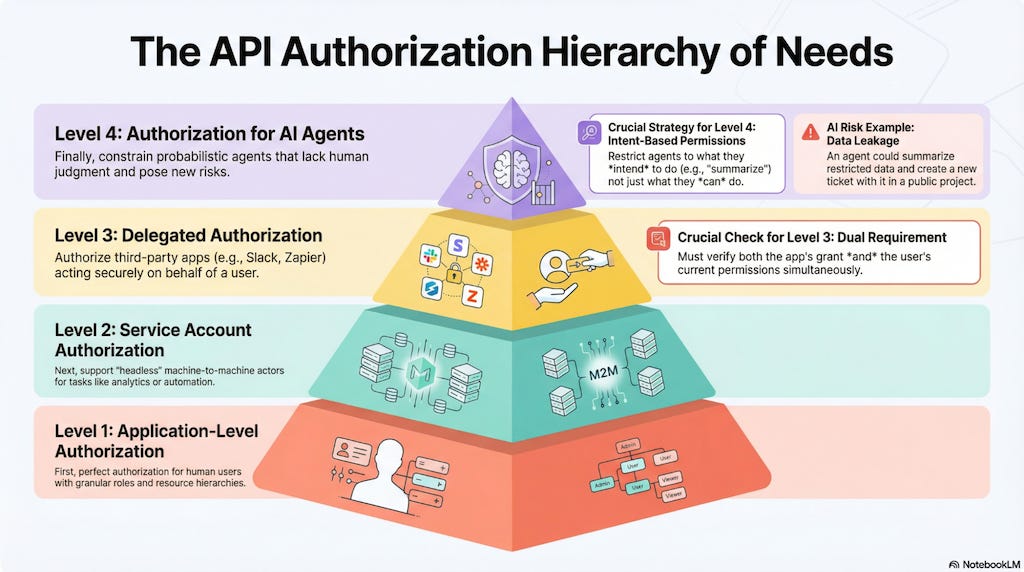
Ethereum New Proposal - ERC-8126: AI Agent Registration and The API Authorization Hierarchy of Needs: Why You Aren’t Ready for AI Agents YetVerification
The Future of Digital Trust: Why Your Organization Needs Verifiable AI
Verifiable AI works the same way. Instead of blindly trusting an AI system’s output, it ensures that every action and decision can be proven—who deployed the AI, what it is authorized to do, and whether it followed the required rules. This is where Verifiable Credentials play a critical role: they act as the visas attached to the AI’s passport, defining scope, permission, and compliance, and making trust verifiable, enforceable, and reusable as AI systems operate across platforms and ecosystems.
The Gradual Revolution of “Agentic Everything”
The answer lies in a simple, yet catastrophic, architectural omission from the 1970s. When the internet protocols (TCP/IP) were designed, they were built to move Data—what philosophers like John Searle call “Brute Facts.” The network is brilliant at proving that I sent you a file. It is perfect at moving a packet of information from Point A to Point B without corruption. It solves the physics of information transport perfectly.
But the internet has no concept of Value—what Searle calls “Institutional Facts.” An Institutional Fact is a social agreement that exists only because we say it does: “This piece of paper is worth five euros,” “I am over 18,” or “I owe you a favor.” The internet cannot natively prove that I am who I say I am, or that I owe you money. It can send a PDF of a contract, but it cannot enforce the “handshake” that makes the contract valid.
Import Your ChatGPT or Claude History to Kin
Government Updates
UK Scraps Digital ID Requirement for Work Checks Amid Growing Privacy Backlash
A blueprint for modern digital government (HTML)
This change will be led by the new digital centre of government. The digital centre exists to serve the public, departments and the wider public sector. It will be magnetic: the home of specialist expertise in digital service design, artificial intelligence and other areas. It will be catalytic: enabling teams to work together more easily to deliver the government’s missions and power public sector reform.
Our approach to keeping GOV.UK One Login secure
In the GOV.UK One Login programme our security model involves multiple lines of protection, such as monitoring for threats, controlling access to systems, and keeping detailed logs. We regularly review and update these measures to stay ahead of any new risks.
Building Resilient Payment Systems in Fragile States: Lessons from the IMF and the Role of Offline Digital Finance
Paycode enhances national ID systems with offline biometric authentication and is now integrating self-sovereign identity (SSI) models to ensure continuity even when central systems are unreachable.