With this innovation competition, the Federal Ministry for Economic Affairs and Climate Action (BMWK) is directly contributing to Germany’s digital sovereignty and data security on the Internet. The measure aims to strengthen the confidence of citizens and companies in digital transformation.
Come and make the world a better place by writing software for creating, managing, and using privacy-focused verifiable credentials! The ideal candidate will design and code software and user interfaces for decentralized identity applications using Node.js, Express.js, and React.js.
Turning identifying features into verified credentials
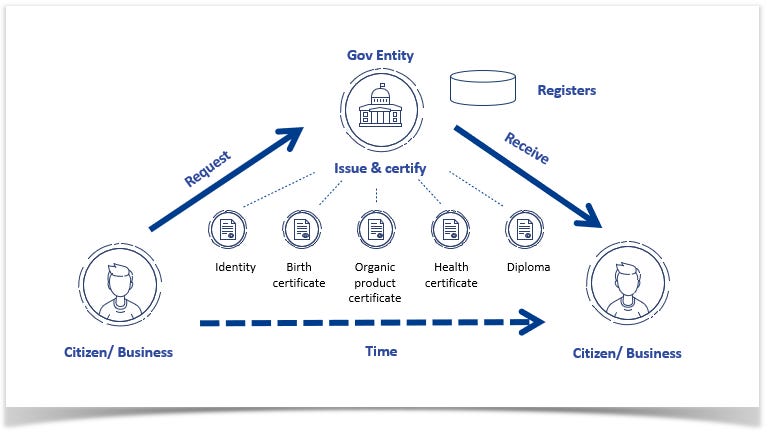
How exactly does this work? Let’s look at the three roles of user, issuer and verifier. Firstly, users can have any number of attributes – such as their credit rating, national identity document or driving licence – certified by the entity responsible for each attribute.
Since we are experiencing massive boosts in our digital economy in the form of investment and innovation, being able to secure and "own" our PII is crucial. In an unprecedented time of hackable honey pots, we need to be able to protect our online and offline identities.
The SSI identity system gives you the ability to authenticate your own identity, using credentials you have been issued or information you can verify directly, which is stored in a digital wallet.
This self-sovereign capability of associating the artist, the collector and the art work itself with an identity — creates value for everyone. We did also share that the opportunity of secondary sale income / commission that could be attributed back to him as the original artists is also possible (albeit very complicated).
On the @IAlsoPodcast, partner Charlyn Ho discusses w/hosts @nicolekyle and @SophieWHolm #digitalidentity, how #blockchain empowers users to take control of their data, #privacy under #Web2 vs. #Web3, and more. Tune in 🎧: https://apple.co/3IvGVjr. #womenintech #ialsowantmoney
if you wonder how many of us, users, can really take advantage of PKI for identifying ourselves on the internet, the answer is quite deceiving. This mature technology has been available for decades but has never become mainstream among the society for identifying end users.
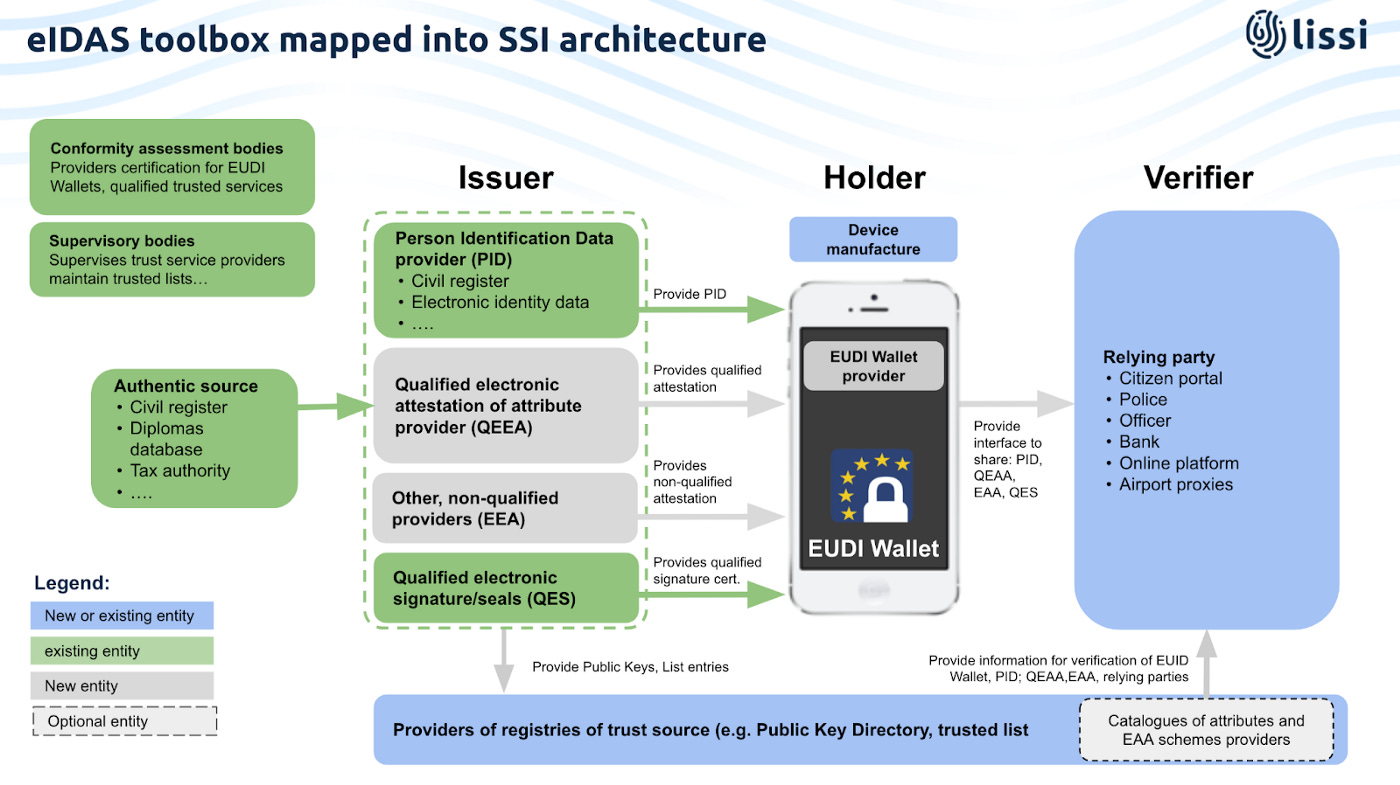
In the graphic below we reorganised and regrouped the stakeholders to map the requirements for the eIDAS toolbox architecture onto a SSI framework (Self-Sovereign Identity framework).
Broadly, we at Evernym/Avast are impressed with the content and the underlying principles in the Framework. There’s a lot that we like, but there are also some areas of significant concern that need careful attention.
The EU Commission did reflect on the effectiveness of the regulation in its Impact Assessment, and is developing a revision of it. There are multiple revision options being discussed, but thus far, the preferred option would establish a framework that provides citizens with optional use of a personal digital wallet
Governments and the societies they serve need technology capable of verifying the authenticity of the information they handle.
As we build the European regulatory framework, in the transfer from paper to digital, a key question arises: how to share official documents, called ‘evidences’ or ‘credentials’ in a way that can be trusted?
Validated ID participates in a project to build the European Blockchain Services Infrastructure (EBSI) for the support of cross-border public services, an initiative created by the European Commission. EBSI is developing a strong and mature ecosystem that Validated ID is proud to be part of.
Innovate: DeFi compliance on top of Layer 1 Utilities (Shyft, Notabene, Centre), payments for Verifiable Credentials (cheqd, Kilt, Velocity), overlay networks (did:ion, did:tz, did:orb), KERI and self-certifying identifiers, self-executable governance (to name a few!) are all Layer 1 Utility innovations on the horizon. Let us know what you’d like to see going forward and how we can build guidance and documentation around it!
The OpenID Foundation is pleased to announce the launch of the Global Assured Identity Network (GAIN) Proof of Concept Community Group, which aims to test the technical hypotheses underlying the “GAIN Digital Trust” white paper.
The amount of utopian bullshit and fake promises on a technology that doesn’t really work as anything but a speculative bubble and money laundering device should be a big red flag. Crypto is a movement based on the theory that the existing nation-state is a system rigged by billionaires, and the right response is to create a different and more corrupt order rigged by different billionaires, money launderers, and dictators.
Web3 social media? Decentralized identity? Digital society in the metaverse? On this episode, we unpack the future social world in the metaverse and the protocols that will help shape it.
There’s a thread in a list I’m on titled “NFTs are a Scam.” I know too little about NFTs to do more than dump here three thoughts I shared on the list in response to a post that suggested that owning digital seemed to be a mania of some kind. Here goes…
In the three years since we’ve been active as a Web3 company, this is the second time we had the opportunity to participate in this massive gathering of some of the brightest minds in the Web3 space. What better way to open our presence at ETHDenver than to become official sponsors of the Opening Party?
In sum, SSI saves time, enhances security, and returns personal data ownership to individuals, thereby lessening the power of GAFA [Google, Apple, Facebook, and Amazon].
Still not excited about tokenization of credential exchange. (Kaliya)
A game changing, blockchain based, public utility layer, which makes it simple for people and organizations to exchange verifiable, immutable, trusted self-sovereign career credentials.
Ask ten people what privacy is and you'll likely get twelve different answers. The reason for the disparity is that your feelings about privacy depend on context and your experience. Privacy is not a purely technical issue, but a human one.
We analyzed GitHub issues to find breakdowns when syndicating between brid.gy and Facebook. Results explore how alternative social media can coexist w/ the corporate web
Bridging the Open Web and APIs: Alternative Social Media Alongside the Corporate Web.
The present project is aimed to deliberate upon the feasibility, benefits and privacy concerns associated with different identity models. All possible decentralized identity models shall be audited in light of data protection, immutability, revocation, accountability, auditability, speed and users control over the personally identifiable information...... and the one that promises self-sovereign identity, shall be worked out with associated bare-bone framework.
Today, we want to celebrate our ten years, reflecting on what we have accomplished and anticipating the future, because we are sure that there will be many more to come. As a result, we want to reaffirm our commitment to our objectives and mission.
I think this piece is full of inaccuracies - it is also put together by someone really trying to understand a bunch of different things that get merged into “all that bad blockchain technology that deprives people of dignity and rights”. Unless we figure out how to differentiate what we are doing from others we will all get lumped together. (Kaliya)
It’s time activists began to develop a working knowledge of Blockchain and self-sovereign digital identity, because these are the mechanisms that will drive the transition to IoT monitoring for the purposes of Pay for Success deal evaluation
While US-based entities are adhering to an enhanced regulatory framework, these mandates are particularly applicable in Europe, where there is necessary compliance with enacted standards (such as the General Data Protection Regulation—commonly known as GDPR—and the Payment Service Providers Directive 2—referred to as PSD2. A clear need for a true and persistent digital identity as a solution to the ancillary—and sometimes unforeseen—challenges that have arisen.